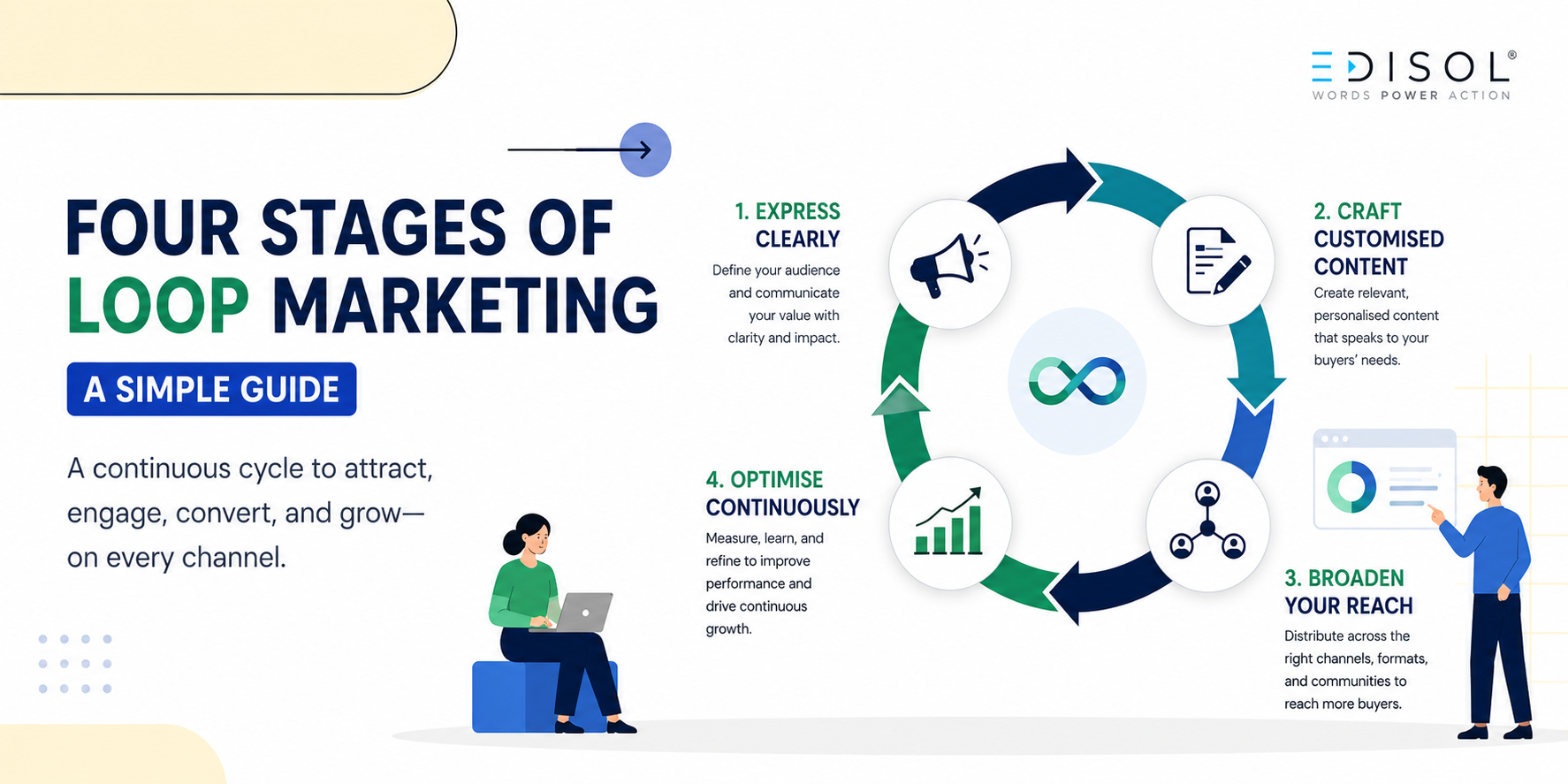
The era when marketing controlled the buyer’s journey is over. Today’s B2B buyers move across channels, communities, and creators, shaping their own path to purchase. While inbound marketing strategies will help boost your business by transforming how brands engage with their prospects, modern B2B buyers do not follow a linear journey.
Buyers now rely on marketing loops and AI-generated tools to compare, discover, and evaluate options. Growth no longer depends only on acquisition. It depends just as much on retention and expansion, with the loop influencing both AI-led discovery and human engagement.
With loop marketing, buyers learn what works and optimise what doesn’t. They then use the data for their next campaign. Inbound marketing still plays a role, but it is no longer enough on its own. Loop marketing builds on it by integrating AI Engine Optimisation (AEO) and continuous data feedback. This approach reflects today’s reality, where nearly 60% of Google searches end without a click[1].
Understanding Loop Marketing
Loop marketing is a continuous, feedback-driven approach where every interaction improves the next one. Instead of a linear journey, it works as a cycle that connects discovery, engagement, conversion, and retention.
Data sits at the centre of this loop. Buyer actions feed back into the system, helping refine messaging, targeting, and content in real time. It builds on inbound marketing, but goes further. You do not just attract and convert — you learn, adapt, and re-engage, creating a system that compounds over time.
Inbound Marketing vs Loop Marketing
Inbound marketing built the foundation, but buyer journeys are now spread across multiple touchpoints. Loop marketing reflects this shift, focusing on continuous engagement, real-time learning, and adapting to how buyers discover and decide.
The table below breaks down how the two approaches differ.
| Aspect | Inbound Marketing | Loop Marketing |
|---|---|---|
| Core Model | Step-by-step funnel (Attract → Engage → Convert → Delight) |
Ongoing cycle (Express → Tailor → Amplify → Evolve) |
| Primary Focus | Attracting users through useful, relevant content | Continuously refining and personalising interactions with AI |
| Search Approach | SEO-led (focused on clicks and rankings) | SEO + AEO (focused on visibility within answers) |
| Content Style | Campaign-based, largely static | Adaptive, iterative, and multi-format |
| Personalisation | Segment and persona-driven | Individual-level personalisation using CRM and behaviour data |
| Distribution Channels | Website, blogs, email, search | Integrated across search, AI platforms, social, creators, and communities |
| Engagement Method | Funnel-based nurturing | Always-on, context-aware engagement |
| Execution Cadence | Periodic campaigns and reviews | Continuous testing, iteration, and optimisation |
| Optimisation Style | Insights applied after campaigns | Real-time adjustments based on live data |
| Success Metrics | Traffic, rankings, lead volume | Depth of engagement, AI visibility, share-of-answer, loop efficiency |
| Buyer Journey | Guided by brand stages | Non-linear, driven by buyer behaviour |
| Positioning | Core foundation for growth | Advanced layer that builds on and extends inbound |
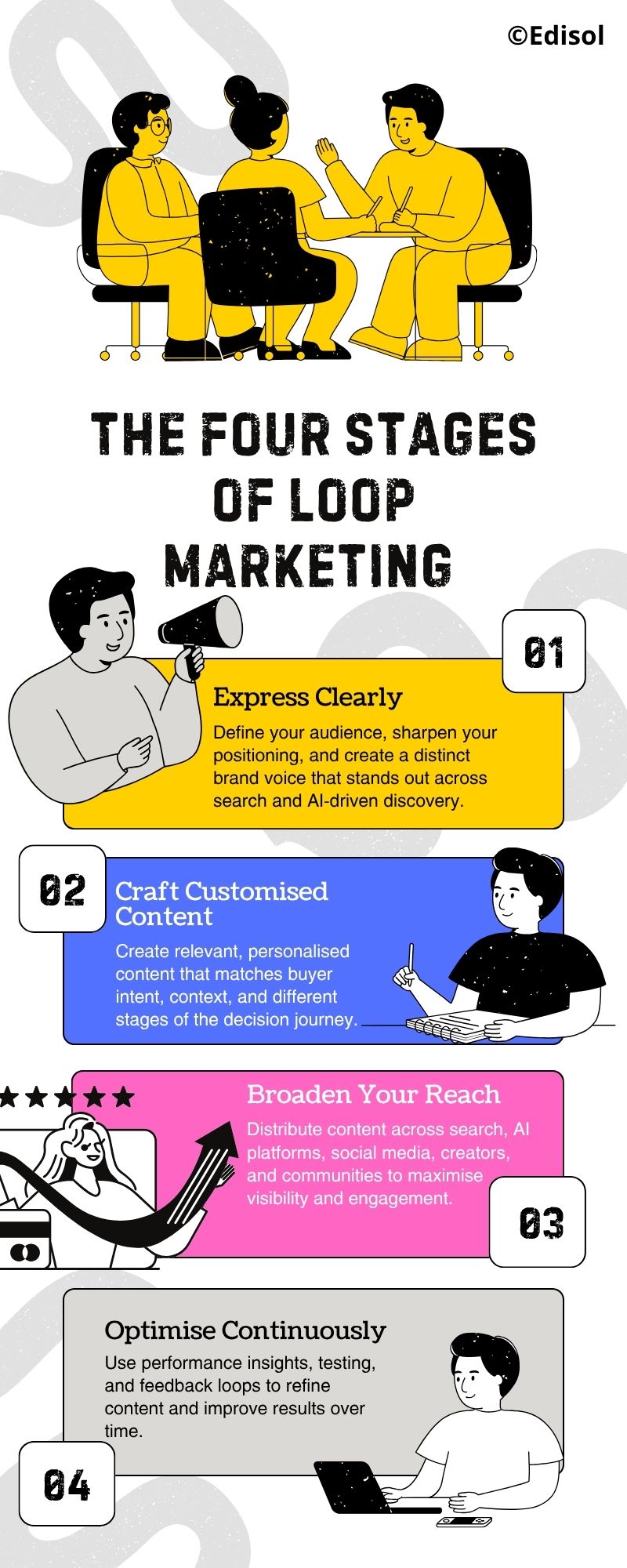
The Four Stages of Loop Marketing
The four stages of loop marketing work as a connected system, combining AI-driven insights with human judgement to continuously improve performance. It combines the intelligence of emerging trends in AI-driven content creation with human creativity at every stage.
1. Express Clearly
Everyone uses the same AI tools. The difference lies in how clearly you define your audience and position your brand. It is about building a distinct voice, clear messaging, and positioning. Brands must have a content strategy that improves visibility across search engines and AI-driven discovery.
2. Craft Customised Content
Buyers are not interested in generic details. They expect relevance and personalisation. Tailor your messaging to specific needs, contexts, and timing. Your messaging needs to align with where they are in their decision journey. User-generated content (UGC) also plays a key role in building credibility.
Nearly 80% of consumers say UGC strongly influences what they buy, making your audience a credible and powerful driver of growth[2].
3. Broaden Your Reach
Buyers engage across multiple platforms, not just traditional channels. AI helps make your content discoverable across both search and AI-powered interfaces. It also enables content repurposing across formats, while human input ensures authenticity.
About 74% of marketers rely on 3-8 different marketing channels, such as social media and email marketing, to amplify their reach and engagement[3].
4. Optimise
Marketing loops thrive on constant learning. AI predicts insights, experiments, and real-time adjustments. Refresh your content regularly to align with your brand’s growth goals. It is with continuous optimisation that you evolve.
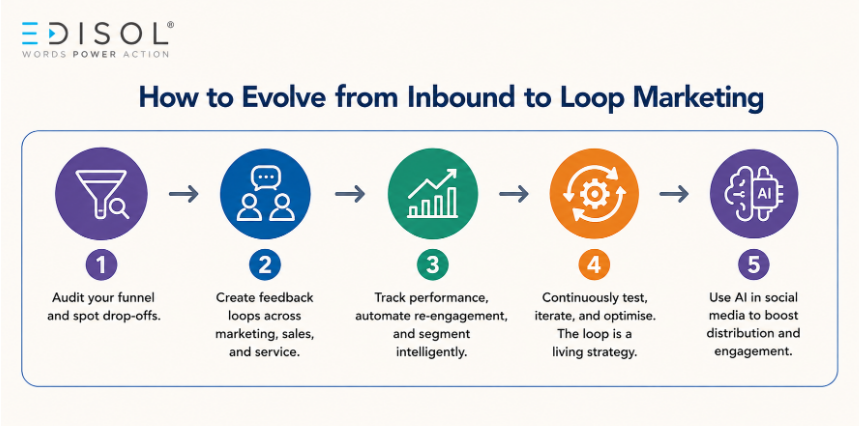
How to Evolve to Loop Marketing from Inbound Marketing
If your inbound marketing is performing well, it is easy to build the foundation of your loop marketing. With loop marketing, you can amplify what works for you and remove the gaps that affect growth. These are the ways to evolve from inbound marketing to loop marketing:
- Check your current funnel and identify the areas where the engagement stops or weakens
- Create feedback loops where the marketing, service, and sales can share data and insights
- Track performances, automate re-engagement, and segment intelligently
- Continuous optimisation is what makes the difference because a marketing loop is a living strategy
- Understand how to use AI in social media marketing to improve distribution and engagement
Why Loop Marketing is Important Today
Loop marketing is evolving, and it matters in today’s business climate to fuel growth. The loop is a reflection of the current reality. Here’s how:
- Every customer interaction gives way to the next
- The system improves with every step, signaling growth
- For loops, all customers are catalysts for continuous growth
- A good combination of data and AI makes the loops possible
- Loops move away from a growth mindset and concentrate on business wins by enhancing customer value across the full lifecycle and acquisition
Conclusion
There is definitely a change in the way you now approach your brand’s growth and customer engagement. Unlike conventional marketing patterns that rely on predictability and linear pathways, marketing loops create a continuous cycle that becomes effective with each iteration.
At Edisol, our strategy teams help you build a framework that aligns with modern buyers and ensure that your customers receive information across multiple marketing platforms. Contact us to get started!
Frequently Asked Questions
What is loop marketing?
Loop marketing is a growth framework that replaces the usual funnel with a continuous cycle of customer engagement. This marketing loop strategy works through a continuous four-step cycle: express, tailor, amplify, and diversify.
How is loop marketing different from inbound marketing?
Loop marketing turns the data inbound marketing collects into a strategy. Marketing loops never end. Every customer interaction signals towards acquisition, expansion, or retention. It is only when marketing, service, and sales are connected that growth happens.
Can small brands use loop marketing?
Yes, they can. Small brands can run market loops with fewer tools and faster feedback cycles. Consistency is more important than the size of the brand.
How long does it take for a business to see the results from loop marketing? You can expect early signals in 30 days. There will be an AI citation movement or a better search result for your brand in 30 to 90 days. This will depend on the crawl frequency and the competition.
Which tools can you use to implement loop marketing?
These are the tools that support every stage of the marketing loop strategy: Analytics and reporting dashboard for campaigning performance at every stage
- AEO and SEO optimisation tools such as Semrush, Google Search Console, and HubSpot SEO tools help to rank your content and earn AI citations
- Collaboration tools to keep marketing and sales teams aligned
- CRM Platform to centralise marketing, sales, and service data while automating lead scoring, segmentation, and reporting
- Marketing automation software to personalise consistent messaging, power nurturing, and social publishing
What are the 4 stages of the marketing process?
The marketing process has four stages: awareness, consideration, conversion, and loyalty. Each stage aims to attract, inform, convert, and retain customers effectively. Together, they build lasting relationships and support sustainable business growth.
References


